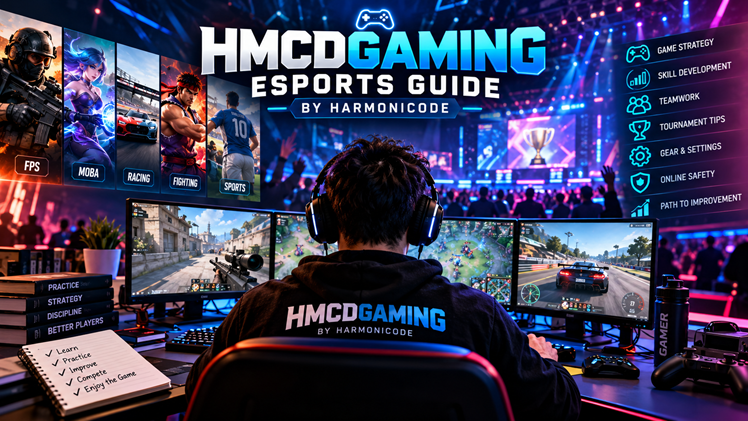

Esports has transformed competitive gaming into a global form of entertainment. Players compete in organized tournaments, represent professional teams, and build careers around their favorite games. Yet getting started can feel overwhelming, especially for beginners who don’t know which games to choose or how to improve. The HMCDGaming esports guide by Harmonicode explores the fundamentals of competitive gaming, from choosing a suitable title to developing better mechanics, teamwork, and tournament skills. It provides a starting point for readers who want to approach gaming more strategically.
Whether you enjoy tactical shooters, multiplayer online battle arenas (MOBAs), fighting games, or sports simulations, improvement begins with understanding the basics. You don’t need expensive equipment or professional experience to get started. Consistent practice, realistic goals, and a willingness to learn can make a meaningful difference.
This guide examines popular esports genres, essential player skills, effective training routines, equipment choices, and tournament preparation. It also covers online safety and responsible gaming habits.
Editorial transparency: This article provides independent educational information about competitive gaming. It does not claim that HMCDGaming or Harmonicode operates a professional esports league, hosts tournaments, or provides specific services without independent verification.
What Is the HMCDGaming Esports Guide by Harmonicode?
The phrase hmcdgaming esports guide by harmonicode describes an esports-focused topic centered on competitive gaming education. Its core themes include game strategy, skill development, tournament participation, and the habits that help players improve.
Unlike casual gaming, esports typically involves structured competition under established rules. Players may compete through ranked matchmaking, organized leagues, online tournaments, or live events. Depending on the game, success can depend on individual performance, team coordination, or a combination of both.
A useful esports guide goes beyond explaining controls. It helps players understand decision-making, communication, equipment, practice methods, and competitive expectations.
These fundamentals benefit newcomers and experienced players alike. Beginners can build a solid foundation, while more advanced competitors can identify weaknesses and refine their preparation.
Who Can Benefit From This Guide?
The guide’s subject matter can help several types of readers:
- Beginners: Understand esports terminology, game mechanics, and competitive rules.
- Casual gamers: Improve consistency and make smarter decisions during matches.
- Ranked players: Develop focused training routines and review gameplay mistakes.
- Aspiring competitors: Learn about team roles, tournament formats, and competitive preparation.
- Parents and guardians: Better understand online gaming environments, privacy, and healthy play habits.
Your starting point should reflect your experience. New players should prioritize basic mechanics and game knowledge. Experienced competitors may gain more from replay analysis, advanced strategies, and team coordination.
Understanding the Esports Landscape
Esports includes several genres, each with its own competitive demands. Understanding their differences can help you find a game that matches your interests and strengths.
1. First-Person Shooters
First-person shooters, commonly known as FPS games, emphasize aiming, movement, positioning, and reaction time.
Games such as VALORANT and Counter-Strike 2 illustrate how tactical shooters reward preparation and teamwork. Players must understand map layouts, manage resources, communicate enemy positions, and coordinate their actions.
Beginners should concentrate on crosshair placement, movement control, and communication before obsessing over reaction speed. Strong fundamentals often matter more than flashy individual plays.
2. Multiplayer Online Battle Arenas
Multiplayer online battle arenas, or MOBAs, combine character abilities, team strategy, resource management, and map awareness.
League of Legends and Dota 2 are prominent examples. Players must understand their roles, manage objectives, and recognize when to support teammates or pursue individual advantages.
Learning one role thoroughly is often more productive than switching between several roles every match. Once you understand your responsibilities, expanding your knowledge becomes easier.
3. Sports and Racing Games
Sports simulations and racing games attract players who enjoy structured competition built around familiar activities.
EA SPORTS FC emphasizes tactical decisions, precise controls, and attacking patterns. Competitive racing titles demand consistent driving, track knowledge, and careful braking.
These genres can appeal to players who prefer direct competition without the broader strategic complexity of a large team-based game.
4. Fighting Games
Fighting games emphasize timing, spacing, execution, and the ability to adapt to an opponent.
Street Fighter 6, for example, rewards players who understand defensive options, recognize unsafe attacks, and respond to predictable behavior.
Beginners don’t need to memorize complicated combinations immediately. Learning basic attacks, blocking, movement, and a few reliable combos provides a stronger starting point.
How to Choose the Right Esports Game
A game’s popularity doesn’t automatically make it the right choice for you. Your interests, available hardware, schedule, and preferred competitive style should influence your decision.
Consider these factors before committing to a particular title:
- Personal interest: Choose a game you genuinely enjoy. Motivation makes consistent practice easier.
- Hardware requirements: Confirm that your computer or console can run the game reliably.
- Learning curve: Some titles require extensive knowledge of maps, characters, or advanced mechanics.
- Competition format: Decide whether you prefer individual competition or coordinated team play.
- Community activity: Look for active ranked modes, learning resources, and legitimate tournaments.
- Time commitment: Choose a game that fits your work, school, and personal responsibilities.
Try two or three games before settling on one. Spend enough time with each to understand its mechanics and competitive structure.
Once you’ve made your choice, give yourself time to improve. Constantly switching games after a few losses makes it harder to recognize patterns and measure progress.
Essential Skills Every Esports Player Should Develop
Competitive success involves more than quick reflexes. Mechanical ability, strategic thinking, communication, and adaptability all contribute to performance.
Mechanical Skills
Mechanical skills are the physical inputs and actions you perform during a match. They include aiming, movement, timing, controller precision, and ability execution.
Focus on the mechanics that matter most in your chosen game. An FPS player might practice tracking and recoil control. A fighting-game competitor might work on blocking and punishing unsafe moves.
Keep practice sessions focused. Repeating the same mistake for an hour is less useful than identifying the problem and correcting it through deliberate drills.
Game Sense and Strategic Thinking
Game sense means understanding the current situation and anticipating what might happen next.
Consider an FPS player who notices that opponents repeatedly attack the same location. Instead of waiting for another attack, the player can reposition or ask a teammate to cover the area.
Develop this skill by asking yourself three questions during matches:
- What information do I have about the opponents?
- Which objective matters most right now?
- What risks could undermine my current plan?
These questions encourage deliberate decisions instead of impulsive reactions. Over time, recognizing familiar situations becomes easier.
Teamwork and Communication
Team-based esports depends on clear, timely communication. Long explanations during an active fight can distract teammates and delay important decisions.
Effective communication involves:
- Reporting enemy positions accurately.
- Sharing information about cooldowns and available resources.
- Agreeing on a strategy before executing it.
- Listening to teammates without talking over them.
- Reviewing mistakes respectfully after a round.
A successful team doesn’t need every player to be exceptional individually. It needs players who understand their responsibilities and work toward a shared objective.
How to Build an Effective Esports Training Routine
Playing more matches doesn’t always lead to better results. A structured routine helps you identify weaknesses, practice specific skills, and evaluate progress.
Start with a manageable schedule rather than copying the demanding routines of professional players. Your training should fit your daily responsibilities and leave enough time for rest.
A Sample 60-Minute Practice Session
This schedule offers a practical starting point for players who want focused improvement without spending an entire evening training.
| Practice activity | Time | Main objective |
|---|---|---|
| Warm-up drills | 10 minutes | Prepare your mechanics |
| Focused skill practice | 15 minutes | Address one specific weakness |
| Ranked matches or scrimmages | 25 minutes | Apply skills under pressure |
| Replay review | 10 minutes | Identify mistakes and opportunities |
Adjust the schedule to fit your game. Some titles require longer matches, while others allow shorter practice sessions.
During replay review, focus on two or three important decisions. Look for positioning errors, missed opportunities, poor timing, or unnecessary risks.
Track Progress With Meaningful Metrics
Winning isn’t the only way to measure improvement. Results fluctuate because of opponents, teammates, and other variables beyond your control.
Instead, track a few indicators that reflect your current goals.
| Metric | What it can reveal |
|---|---|
| Win rate over time | Whether results improve across a meaningful number of matches |
| Accuracy | Whether aiming becomes more consistent |
| Avoidable deaths | Whether positioning or risk management needs attention |
| Objective participation | Whether you contribute to team priorities |
| Communication quality | Whether your calls help teammates make decisions |
Not every metric applies to every game. Choose two or three that match your current weaknesses, then review them weekly.
For example, an FPS player might discover that most deaths happen while crossing exposed areas. That finding suggests a need to improve positioning rather than spend every session practicing aim.
HMCDGaming Esports Guide: Comparing Competitive Game Types
Different esports genres reward different strengths. The following comparison can help you identify a suitable starting point.
| Game type | Core skills | Best suited for |
|---|---|---|
| FPS | Aim, positioning, reaction, communication | Players who enjoy tactical action |
| MOBA | Map awareness, teamwork, resource management | Players who enjoy complex team strategy |
| Fighting | Timing, spacing, execution, adaptation | Players who prefer direct duels |
| Sports simulation | Tactical awareness, precision, pattern recognition | Sports fans who enjoy head-to-head play |
| Racing | Consistency, braking, line selection, control | Players who enjoy precision competition |
These categories share several fundamentals. Every competitive genre rewards practice, sound decisions, and the ability to adapt.
Choose a game that interests you enough to study consistently. A less popular title that keeps you motivated may suit you better than a popular game you don’t enjoy.
Equipment and Settings: What Do You Really Need?
You don’t need an expensive gaming setup to begin competing. Reliable equipment and comfortable settings matter more than owning every accessory on the market.
Start With the Essentials
For PC gaming, prioritize a computer that meets the game’s requirements, a dependable internet connection, and a comfortable keyboard and mouse. A suitable monitor also helps you play consistently.
Console players should focus on a responsive controller, stable network connection, and comfortable display.
A headset can improve communication and help you hear useful audio cues. Choose equipment based on your needs rather than marketing claims.
Optimize Your Settings Carefully
Change settings one at a time. Adjusting sensitivity, key bindings, graphics, and audio simultaneously makes it difficult to determine which changes actually help.
Consider these practical adjustments:
- Choose a mouse sensitivity that allows accurate, repeatable movements.
- Use comfortable key bindings that are easy to reach.
- Reduce unnecessary visual distractions when the game allows it.
- Prioritize stable performance over maximum graphics quality.
- Adjust audio settings so important cues remain clear.
Higher refresh rates can improve motion clarity when your hardware supports them. However, a faster monitor won’t replace good positioning, game knowledge, or consistent practice.
For game-specific advice, consult the official VALORANT beginner’s guide. Riot Games provides information about basic mechanics, communication, and settings through its official beginner guide.
How to Enter Esports Tournaments
Once you understand your game and can compete consistently, consider entering an organized event. You don’t need to aim for a professional contract immediately.
Community competitions and online tournaments offer opportunities to face unfamiliar opponents, practice under pressure, and learn how organized events work.
Steps for Your First Competition
1. Find a suitable event. Look for beginner-friendly community tournaments, amateur leagues, or local competitions.
2. Read the rules. Check eligibility, team size, game version, match format, and prohibited software.
3. Confirm the schedule. Make sure you can attend every required match and meet registration deadlines.
4. Prepare your setup. Test your internet connection, controls, audio, and game updates beforehand.
5. Practice with teammates. Agree on roles, communication methods, and basic strategies before competing.
6. Review your performance. After the event, identify what worked and what you need to improve.
Check announcements through official game channels or established tournament organizers. Familiar branding alone doesn’t prove that a competition is legitimate.
Understand Common Tournament Formats
Competitive events use different formats, and each affects how players progress.
- Single elimination: A competitor usually leaves the bracket after one loss.
- Double elimination: Competitors generally receive another opportunity after their first loss.
- Round robin: Each participant or team plays multiple opponents within the group.
The organizer’s rulebook determines the exact structure. Read it carefully before registering, especially when an event charges entry fees or offers prizes.
Pros and Cons of Following an Esports Training Framework
A structured approach makes practice more purposeful, but no guide can guarantee a particular rank or professional career.
Pros
- Clear direction: A training plan helps you decide what to practice.
- Measurable progress: Tracking performance makes improvements easier to recognize.
- Better teamwork: Communication exercises encourage coordinated play.
- More focused practice: Specific drills reduce time spent playing without a clear objective.
- Greater self-awareness: Reviewing replays reveals recurring mistakes.
Cons
- Requires consistency: Competitive skills develop through repeated practice.
- Can feel demanding: Excessive tracking may reduce enjoyment.
- Results vary: Progress depends on experience, practice quality, and competition.
- Equipment has limits: Better hardware cannot compensate for poor decisions.
- Competitive pressure can affect enjoyment: Constantly chasing rankings may create unnecessary stress.
The best approach balances improvement with enjoyment. If training becomes exhausting, shorten your sessions and reassess your goals.
Expert Tips for Improving Competitive Performance
Small changes to your habits can make practice more productive. These recommendations apply to beginners and experienced competitors alike.
1. Focus on One Weakness at a Time
Trying to fix every problem in one session rarely works. Identify your most common mistake and practice a specific solution.
If you repeatedly lose fights because of poor positioning, spend several sessions studying angles, cover, and safer movement.
2. Review Losses Without Blaming Teammates
A teammate’s mistake may contribute to a defeat, but you can still learn from your own decisions.
Ask whether you could have communicated earlier, chosen a safer position, or responded differently. This approach turns frustration into something you can address during practice.
3. Don’t Copy Professional Players’ Settings Blindly
Professional players have different preferences, equipment, and experience levels. Their settings may not suit your playstyle.
Test changes individually and keep the settings that improve your consistency. Give yourself enough time to adjust before deciding whether a change works.
4. Manage Fatigue and Take Breaks
Long sessions can reduce concentration and make repetitive movements uncomfortable. Schedule breaks, maintain a comfortable posture, and stop if you experience pain.
Sleep, hydration, and physical comfort should remain part of your routine. More playing time doesn’t automatically produce better results.
5. Protect Your Account and Personal Information
Use unique passwords and enable multifactor authentication when available. Never share account credentials or verification codes with strangers.
Be cautious about cheats, suspicious downloads, boosting offers, and tournament websites that request unnecessary personal information.
6. Learn From Reliable Sources
Official game documentation provides reliable starting points for mechanics, updates, competitive rules, and eligibility requirements. Community discussions can offer useful perspectives, but verify important claims before acting on them.
For example, Riot Games provides official support information about VALORANT’s competitive systems. Check the VALORANT Support Center for current rules and requirements.
(FAQs) About HMCDGaming Esports Guide by Harmonicode
1. What is the HMCDGaming esports guide by Harmonicode?
The HMCDGaming esports guide by Harmonicode is a topic focused on competitive gaming skills, strategy, training, and tournament preparation. Its principles can help players develop a more structured approach to improving their gameplay.
2. Is HMCDGaming suitable for beginners?
The subject is suitable for beginners who want to understand competitive gaming. Start with basic mechanics, game rules, communication, and simple practice routines before moving on to advanced strategies.
3. How can I improve my esports skills faster?
Focus on one weakness at a time, practice consistently, and review your matches. Track a few meaningful performance indicators rather than relying entirely on wins or losses.
4. Which games are best for competitive esports?
Popular competitive genres include first-person shooters, MOBAs, fighting games, sports simulations, and racing games. The right choice depends on your interests, equipment, preferred playstyle, and access to competitions.
5. Do I need an expensive gaming PC to play esports?
No. Many competitive games support a range of hardware configurations. Start with a device that meets the game’s requirements and provides stable performance. Upgrade only when your current equipment limits your needs.
6. How many hours should I practice esports each day?
There is no universal ideal. Beginners can start with 30 to 60 minutes of focused practice, depending on their schedule and energy levels. Consistency, deliberate practice, and sufficient rest matter more than simply accumulating hours.
7. Can beginners enter esports tournaments?
Yes. Beginners can look for suitable community competitions, amateur leagues, and online events. Review eligibility rules, tournament requirements, and organizer credibility before registering.
8. Does better equipment guarantee higher rankings?
No. Responsive equipment can improve comfort and consistency, but it cannot guarantee better results. Game knowledge, positioning, decision-making, teamwork, and practice remain essential.
Conclusion: HMCDGaming Esports Guide by Harmonicode
The HMCDGaming esports guide by Harmonicode offers a useful starting point for understanding competitive gaming and developing better playing habits. Choosing the right game, practicing deliberately, reviewing mistakes, and communicating effectively can help players build stronger foundations.
Progress often comes from small, repeatable improvements. Better positioning, clearer team communication, and more disciplined practice can address weaknesses that hours of unfocused play leave untouched.
Set realistic goals and measure the skills you can control. Protect your well-being, learn from reliable sources, and give yourself enough time to improve.
Whether you want to climb ranked ladders, enter amateur tournaments, or become more confident in your favorite game, a thoughtful training routine can make your gaming sessions more productive. Competitive success takes time, and results vary. Focus on building lasting skills rather than chasing quick wins.